
Tech Log 01 · The Simulation
Sky & Sea
Most games paint weather on the skybox and call it atmosphere. In Anchor Point the sky is a system — it decides what the water does, what the fish do, what your boat can survive, and what your catch is worth. This is how we build it.
01 · Atmosphere
Real-time weather,
one truth per server
The sky in Anchor Point runs on a real-time, server-driven weather engine of our own. The server owns the forecast: a single authoritative state machine cycles the conditions — from glass-calm clears through fog banks, rain squalls and snow to violent storms and blizzards — and every captain on the server lives under the same sky at the same moment.
When the front rolls in, it rolls in for everyone. Clouds build, light drops, rain sheets across the deck — transitions blend over real seconds, so you can watch a storm assemble on the horizon and decide whether that last string of pots is worth it. No personal-bubble weather, no scripted set-pieces. If the harbor radio says W08, the whole map is in it.
Weather is not cosmetic. Each state feeds four separate simulation channels — market prices, hull speed, catch behaviour and storm risk — which is why reading the sky is the core skill of the game. The journal has the long version of how the weather engine was built.
02 · Hydrodynamics
An ocean
that means it
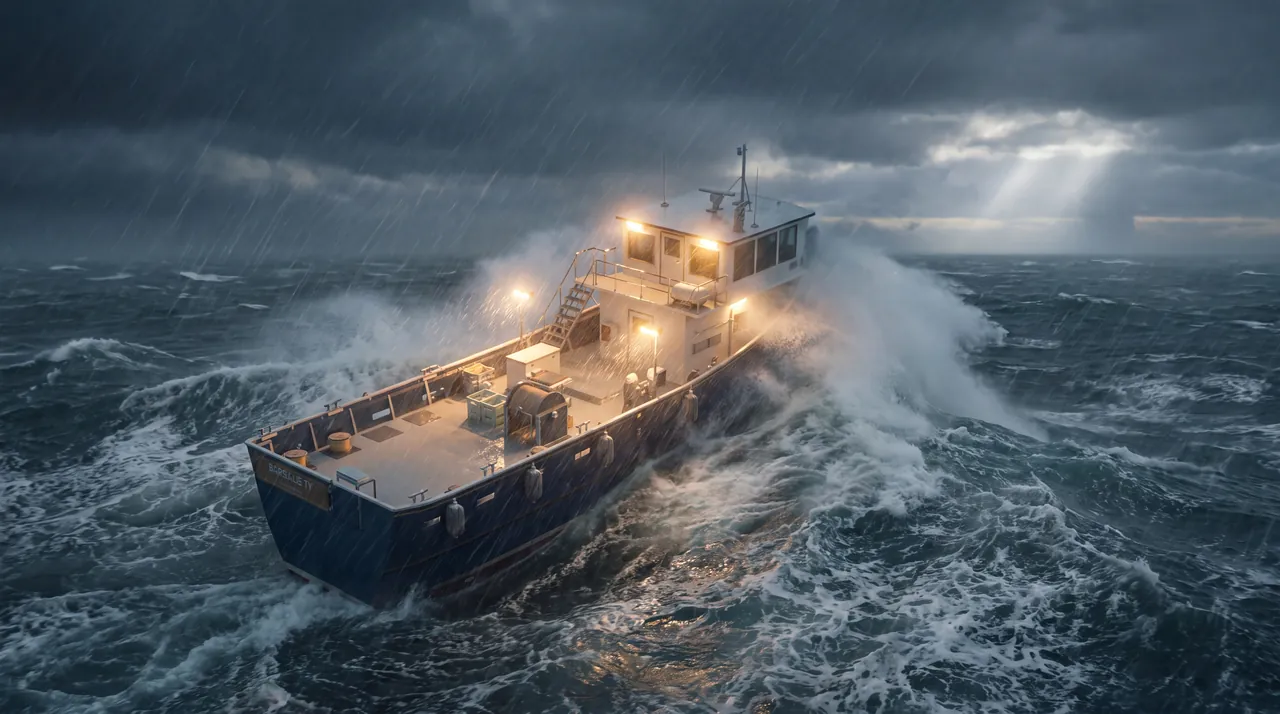
The water is our own: an in-house, ultra-realistic ocean simulation built for one purpose — making the sea a character, not a floor texture. Swell height, chop frequency and foam all derive from the live weather band, so the same bay reads glassy at dawn and feral by afternoon because the simulation changed, not the artwork.
Boats ride that water on four-point buoyancy — bow, stern, port and starboard each sample the surface, so your hull bobs, pitches and rolls with the sea. Every class carries its own weight in the water: a light skiff snaps to each crest while a loaded crabber wallows heavy through it. When the band climbs to a four-metre storm swell, the horizon vanishes behind the next wave and the run for the harbour stops being a straight line.
Under the surface, the water knows the chart. Depth is read straight from real survey bathymetry — so sheltered bays lie flat while the open grounds run rough, channels funnel the weather, and the sounder tells you the truth, because there is a truth to tell.
03 · Consequence
Storms with
a bill attached
A storm in Anchor Point is a business event. The moment the band climbs, four things start happening at once: your hull slows and burns more of its margin per kilometre; some species stop biting while storm-feeders switch on; the risk of losing gear — or part of your hold — becomes real; and back at the dock, fish prices climb, because you're one of the few boats still out.
That last part is the heart of the design. Storms are the game's honest risk-reward dial: dock prices carry a storm premium of up to +15%, so the captains who can read a front — who know it's a Band 2 squall that passes, not a Band 3 system that kills — get paid for that knowledge. Everyone else watches from the harbor saloon.
And because weather, sea state and market all run on the server, nobody's client can disagree about the storm. You can't lag your way out of a gale.
04 · The clock
A world
on a 6:1 clock
Anchor Point runs at six times real time: one full day-night cycle every four real hours, with dawn, working light, dusk and true night. Fishing trips are designed around that rhythm — an honest voyage takes a believable slice of a day, and night runs are a deliberate, riskier choice.
The same clock drives freshness. Every fish carries a real timestamp from the moment it leaves the water and decays through six grades — Prime to Spoiled — in game-hours. There are no arbitrary countdown bars: the value of your hold is a physical consequence of when you caught it, how far you have to sail, and what the weather lets you do about it. Ice buys hours. Distance spends them.
Want to feel the swell yourself?
Pre-register for first-wave playtest access — and a free premium equipment drop when Anchor Point launches.